That stain isn't the leak — it's where the water ended up. We trace it back to the source.
A water stain on a wall or ceiling is a symptom with an address problem: water travels along pipes, joists, and wall cavities before it shows itself, so the visible mark is often feet from the actual leak. Painting over it treats the symptom — the stain comes back because the source is still active.
Professional wall and ceiling leak detection works backward from the stain using moisture mapping, thermal imaging, and acoustic listening to find where the water is actually entering — and just as importantly, to rule out causes that aren't plumbing at all.
Before any instrument comes out, timing narrows the suspect list. A stain that appears or grows after rain points to the roof or flashing — roofer territory, not ours. A stain that's constant regardless of weather points to plumbing. A seasonal or humidity-linked pattern suggests condensation or ventilation issues. And a stain below an upstairs bathroom implicates a fixture, drain, or supply line above.
This differential matters because the fix — and the right professional — differs completely by cause.
The process starts with stain-pattern analysis: a roughly circular stain with a darker center suggests a point source dripping from above; a linear stain along a beam or pipe run suggests water traveling horizontally. Then moisture mapping — systematic pinless-meter readings across the surface — charts the wet area's true extent, which is invariably larger than the visible stain.
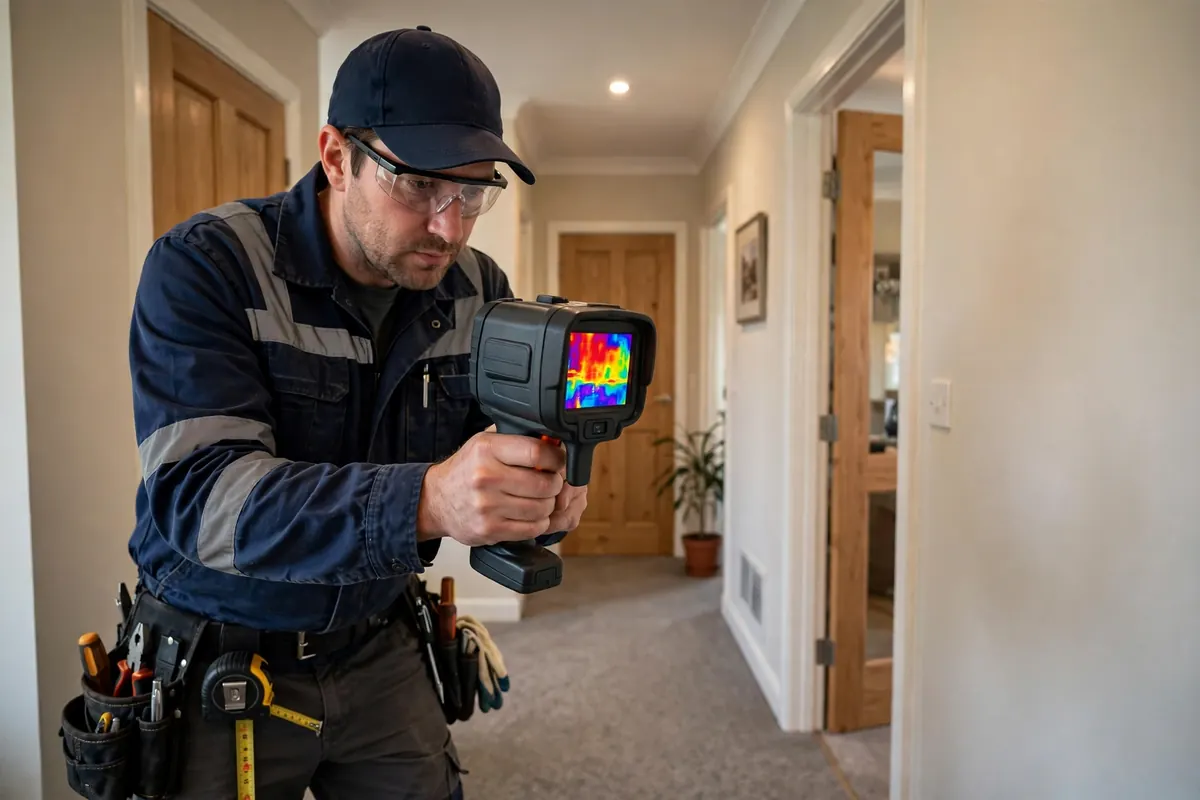
Thermal imaging follows: a cold patch marks a cold-water leak, a warm streak a hot-water one. Where thermal can't resolve it — thick plaster, concrete — acoustic listening pinpoints the pressurized source.
Moisture mapping is the unsung hero of this work. By taking readings on a grid across walls and ceilings, the technician builds a map of elevated moisture that reveals the water's migration path — uphill, so to speak, toward the entry point. It also establishes a baseline: after any repair, re-mapping proves the area is actually drying rather than merely looking dry.
Urgent: active dripping, visibly sagging drywall, or any water near electrical fixtures or outlets — call now. Schedule an inspection: a stable, dry historic stain with no active moisture; it still deserves tracing, but it's not a midnight emergency. Note that a stain can remain visible long after a leak stops — appearance alone doesn't prove active leaking, which is exactly what moisture meters are for.
Two honest boundaries. Roof leaks belong to roofing contractors — if the timing test says rain-driven, we'll tell you to call a roofer rather than sell you a plumbing survey. And mold remediation belongs to restoration specialists; we find and map the moisture, we don't remediate it. Where a plumbing leak has clearly been feeding visible mold, we'll document the moisture and refer the remediation out — each trade in its lane.
Stain pattern, timing history, and the rooms above/beside it narrow the likely cause.
Pinless meter readings on a grid chart the wet area's true extent beyond the visible stain.
Infrared imaging reveals the thermal footprint — cold patch or warm streak — of the active source.
Where needed, listening gear traces the pressurized source through the structure.
The source area is marked and documented with readings and images for targeted repair.
Infrared cameras that read the heat signature of hidden moisture — a non-contact scan with zero damage.
Learn more →Electronic listening that finds hidden leaks through concrete, soil, and flooring — no demolition.
Learn more →Under-slab leaks found and marked without breaking concrete — until the repair needs one precise opening.
Learn more →Water flowing where it shouldn't? Here's what to do right now — and how we help.
Learn more →Every day a hidden leak runs, the water bill climbs and the damage spreads. Call now — we answer 24 hours a day.
+1 424-544-0197 ☎ Call Now Request Leak Detection Service