Leak surveys for buildings that can't afford downtime — documented and minimally disruptive.
Commercial buildings leak differently than houses: bigger systems, longer pipe runs, irrigation and fire-suppression loops, and water bills where a hidden loss hides in five figures of normal usage. Commercial leak detection is a structured survey of those systems — assessment, non-invasive diagnostics, and documented findings a manager can act on.
In Hawthorne — where roughly 70% of households rent and large apartment complexes are common — landlords, property managers, HOAs, and facility managers are the core audience. ("Water loss auditing" is utility-industry jargon for overlapping work; this page is the service customers actually search for.)
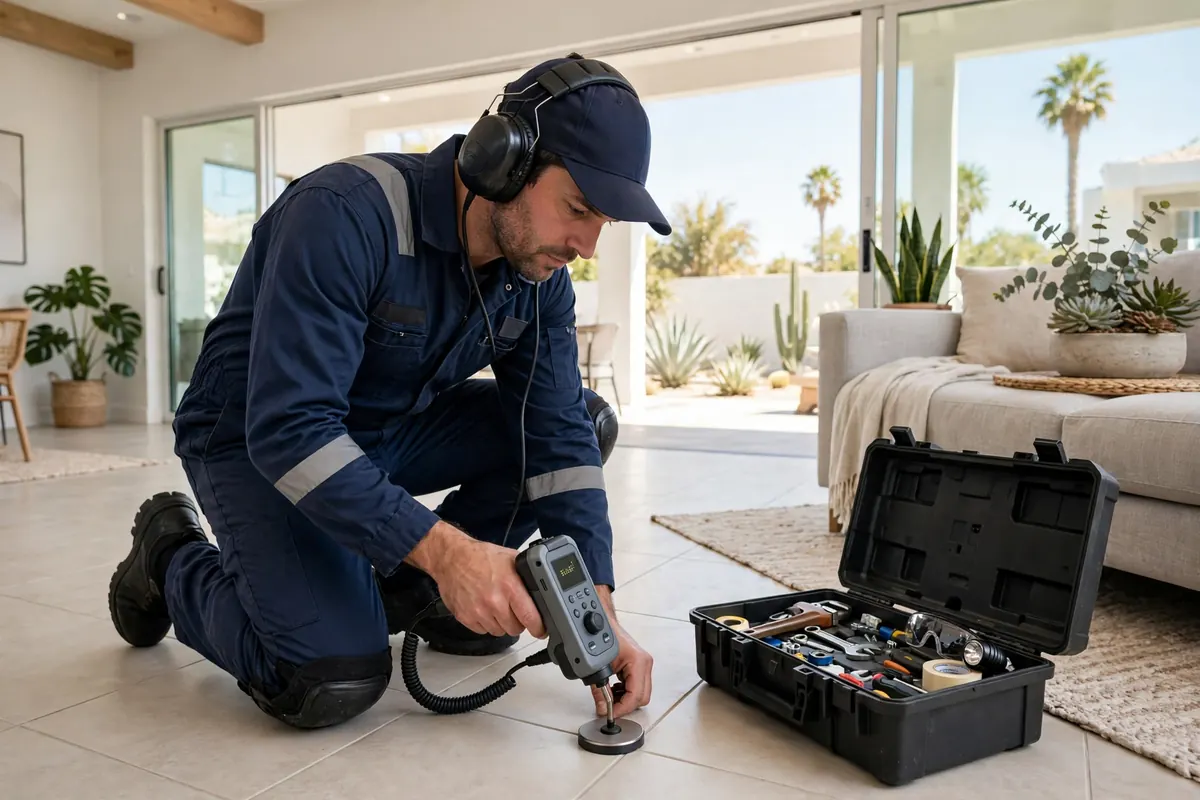
A survey runs in three phases. Assessment first: symptoms, building systems, pipe layouts, meter history, and irrigation schedules. Then non-invasive diagnostics — acoustic listening, thermal imaging, and camera inspection applied across the suspect systems. Finally, documented findings: marked locations and a written report describing what was found and where.
Surveys can be scoped narrowly — a single complaint in one zone — or broadly across a whole property. For HOAs and apartment complexes, a common pattern is a building-by-building rotation that spreads cost across budget cycles while keeping every structure on a known survey date. The scope is agreed in writing before work begins, so there are no surprise line items.
Offices, retail, restaurants, apartment buildings, condos, HOAs, and small municipal or institutional buildings. The systems surveyed include domestic supply mains, irrigation, and fire-suppression loops — surveyed for leak detection, not modified or certified. No promises are made about utility-bill savings; the deliverable is findings, not financial projections.
Commercial work lives or dies on disruption. The methods are non-invasive — sensors on surfaces, cameras through access points — and surveys are scheduled around tenants and operations: early mornings, off-hours, or phased by building section. The goal is answers without shutting down the business running inside the building.
For multi-tenant properties, we coordinate access through your management office rather than knocking on doors — one point of contact, one schedule, minimal confusion for residents. After the survey, the same single contact receives the written report — no chasing technicians for paperwork.
Every survey ends with a written report: what was surveyed, what was found, marked locations, and thermal or video evidence where applicable. That documentation feeds maintenance planning, capital budgeting, and insurance conversations — we provide the facts; we don't promise claim outcomes.
Preventive practice in the water industry points to a yearly or every-other-year survey cadence for larger properties — catching small losses before they become structural or mold problems. Properties with aging galvanized or cast-iron systems, like much of Hawthorne's mid-century building stock, benefit most from staying on a schedule rather than waiting for symptoms.
Between scheduled surveys, the cheapest monitoring is already in your hands: monthly meter readings logged in a spreadsheet. A manager who knows each building's normal baseline will spot the 15–20% creep that signals a hidden loss months before visible damage — and that log is the first thing we review when called in.
Symptoms, meter history, pipe layouts, and irrigation schedules are reviewed before anyone visits.
Acoustic, thermal, and camera diagnostics sweep the suspect systems with minimal disruption.
Anomalies are narrowed to marked locations using the method each situation favors.
Findings, marked locations, and supporting images or video are documented for owners and managers.
We walk through the report and discuss repair or monitoring options — no pressure, just facts.
Electronic listening that finds hidden leaks through concrete, soil, and flooring — no demolition.
Learn more →A safe, inert tracer gas that escapes at the defect and leads us straight to hidden water-pipe leaks.
Learn more →From the meter to your house — we trace underground supply-line leaks to their source.
Learn more →A camera inside your sewer lateral showing exactly what's wrong — roots, cracks, bellies — on live video.
Learn more →Every day a hidden leak runs, the water bill climbs and the damage spreads. Call now — we answer 24 hours a day.
+1 424-544-0197 ☎ Call Now Request Leak Detection Service