Know what's buried before you dig — private locating for the lines you own.
Before any excavation — a fence post, a patio, a repair trench — you need to know where the buried pipes run. Private utility pipe locating traces customer-owned underground lines (your water service, sewer lateral, irrigation, or gas line beyond the meter) and marks their routes on the surface.
This is not the free 811 public service. Calling 811 marks utility-owned lines up to the meter; a private locator handles everything past it — the lines that are yours. If you're planning to dig, call 811 first for the public side, and consider private locating for the rest.
The 811 "call before you dig" service is free and important — but it only covers utility-owned lines, typically up to the meter. Everything on your side of the meter — the water service line to your house, the sewer lateral, irrigation piping, the gas line beyond the meter — is yours, and 811 doesn't mark it.
Private locating fills that gap. It's the service you call when the question is "where are my pipes?" rather than "where are the utility's pipes?"
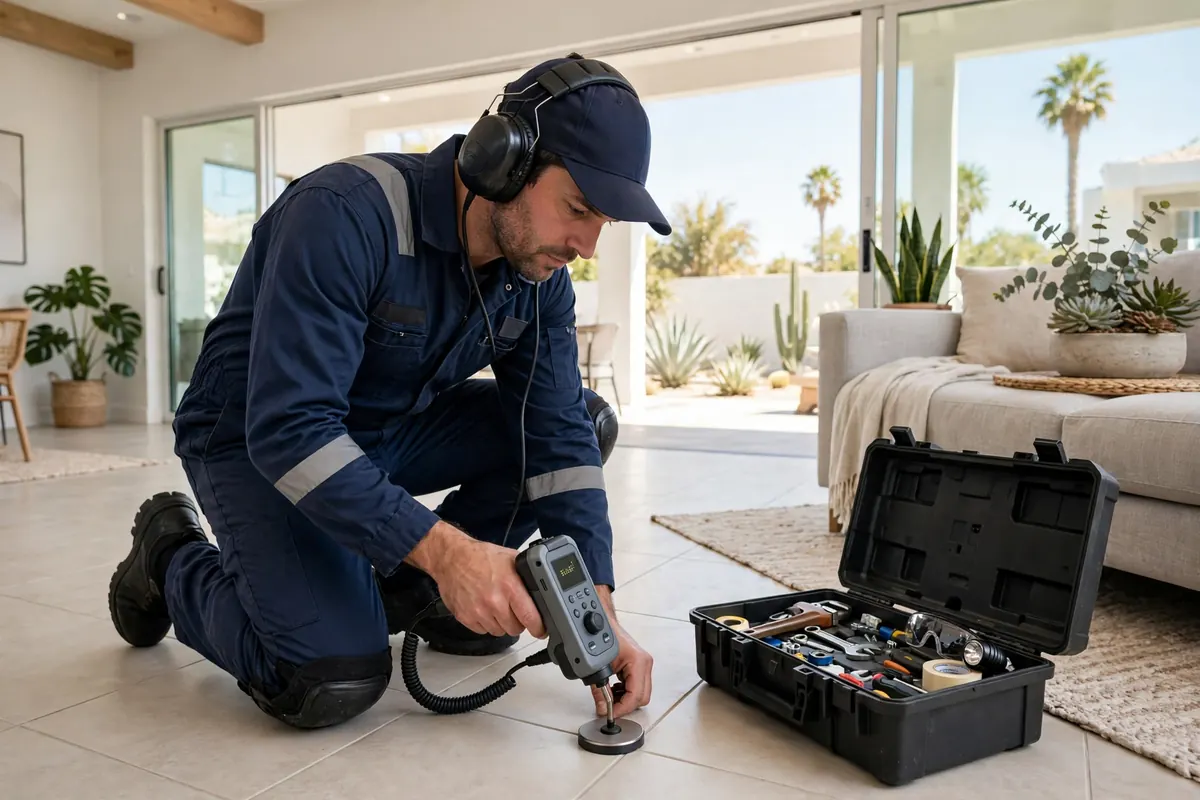
Locators combine methods depending on the pipe and soil. Electromagnetic locating traces conductive pipes (or tracer wires) by inducing and following a signal. Ground penetrating radar (GPR) images the subsurface and can spot non-metallic lines and voids. Record and as-built reviews add context, and everything found is transferred to the surface as paint markings and flags you can work around.
No single tool finds every utility in every condition — that's the industry's own rule of thumb. Accuracy depends on soil type, depth, ground congestion, and pipe material. Plastic pipes are harder to trace electromagnetically without a conductive tracer; congested urban ground with many overlapping lines complicates the picture; and very deep utilities may exceed practical detection range.
A professional locator tells you what was found, what couldn't be confirmed, and where uncertainty remains — rather than painting confident lines over unknowns.
These are related but different jobs. Locating maps a pipe's position; leak detection finds the defect in it. They're often used together — for example, a camera's locator transmitter marks where a sewer defect sits, or a located water-service route guides an underground leak survey. If your actual problem is a suspected leak rather than an unknown route, start with detection.
Pipe locating is a thinner, more specialized demand than leak detection — mostly needed by homeowners planning work, contractors, and property managers. We offer it as a straightforward, honestly scoped service: we'll tell you what we can and can't trace on your property before any marking begins, and we'll never present it as the 811 public service it isn't. And if what you actually need is leak detection rather than route mapping, we'll say so and point you to the right page instead of selling you a locate.
We check available as-built drawings, permits, and your account of the property's history.
Electromagnetic locating and, where appropriate, GPR scan the areas in question.
Confirmed routes are marked with paint and flags, with depth readings where obtainable.
Anything that couldn't be confirmed is flagged as uncertain — not guessed at.
You get a simple sketch of marked routes to plan your work around.
From the meter to your house — we trace underground supply-line leaks to their source.
Learn more →A camera inside your sewer lateral showing exactly what's wrong — roots, cracks, bellies — on live video.
Learn more →A definitive yes-or-no test for drain-line integrity beneath your foundation — before anyone digs.
Learn more →Every day a hidden leak runs, the water bill climbs and the damage spreads. Call now — we answer 24 hours a day.
+1 424-544-0197 ☎ Call Now Request Leak Detection Service