Water flowing where it shouldn't? Here's what to do right now — and how we help.
Some leaks can't wait for business hours: a burst pipe, water pouring through a ceiling, flooding spreading across a floor. Emergency leak detection is our urgent-response service — stop the water first, then find exactly where it's coming from with instruments, even in the middle of the night.
We're open 24 hours, 7 days a week, including holidays. What follows is what counts as an emergency, what to do in the first ten minutes, and what happens when we arrive — with one honest boundary: we never promise specific arrival times we can't guarantee.
1. Shut the main valve. Know where your main water shut-off is before you need it — usually near the meter or where the line enters the house; turn it clockwise. 2. Kill power to wet areas at the breaker if you can do so safely and dry-handed — never touch water near outlets. 3. Move valuables and contain spread with towels. 4. Call us. We'll talk you through anything unclear while help is on the way.
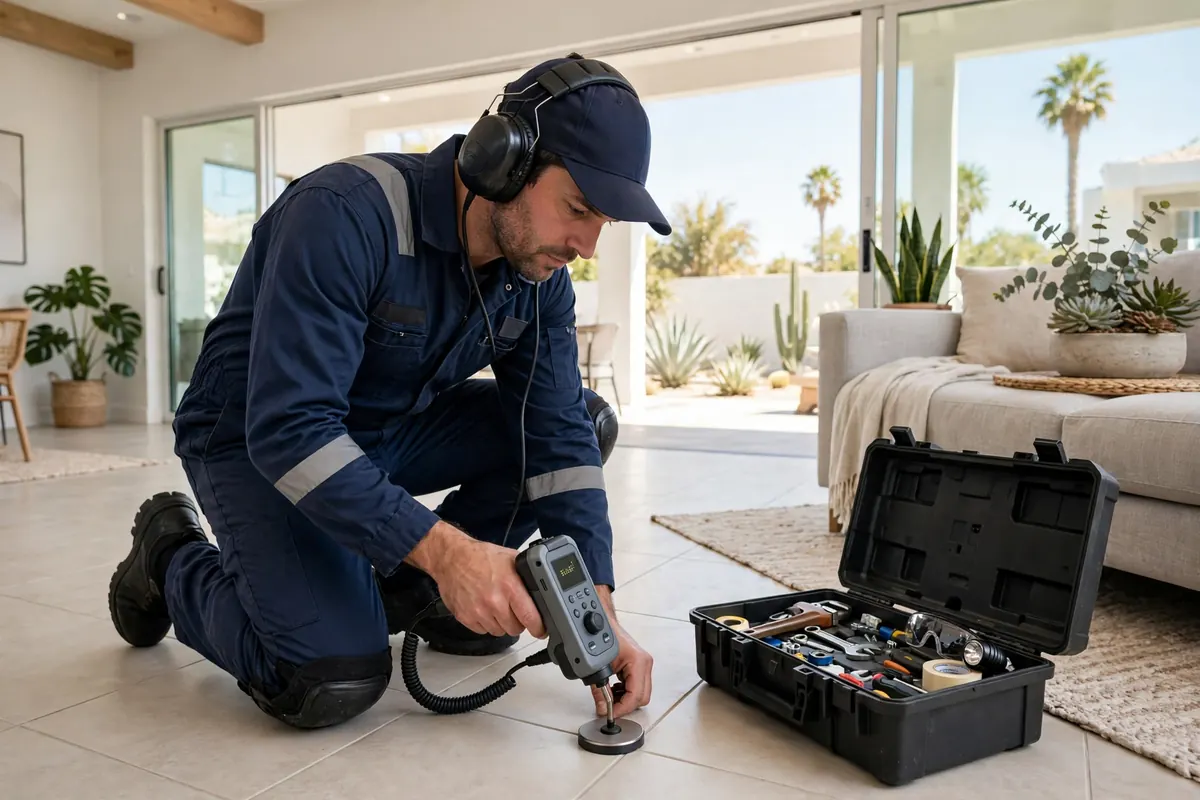
First, the water gets stopped — main valve, fixture valves, whatever the situation needs. Then we assess: what's wet, what's at risk, what can wait. Then the instruments come out — acoustic listening, thermal imaging, moisture meters — to locate the failure precisely, even amid the chaos. Finally, we explain: what broke, what's next, and what you should and shouldn't do before repairs.
It means a human answers at 2 AM on a Sunday, and urgent calls get prioritized scheduling around the clock — nights, weekends, holidays. What it doesn't mean is a promised arrival minute: honest scheduling beats a guarantee we can't keep. When you call, you'll get a straight answer about timing, not a script.
After-hours calls are triaged the same way as daytime ones: stop-the-water guidance first, then scheduling by urgency. A flooding unit outranks a slow drip every time, and we'll say so plainly rather than promising what the queue can't deliver.
A slow drip, a historic stain, a bill that's merely suspicious — none of these need a midnight visit, but none of them improve with waiting either. Mold can begin within 24–48 hours on damp materials, and small leaks become structural ones on their own schedule. If it's not urgent, request a standard visit — but request it soon.
When you call about a non-urgent issue, say so upfront — it helps us schedule you into the right slot instead of the emergency queue, which is better for everyone.
Two special cases. Suspected gas leak: evacuate immediately, don't touch switches, call 911 or the gas utility from outside — see our gas line safety page. Sewer backup: avoid contact with the water, don't run fixtures, and call — it needs professional handling, not a plunger marathon.
We assess urgency on the phone and talk you through immediate shut-off steps.
On arrival, the first job is stopping the flow — main or fixture valves, as the situation needs.
We map what's wet and what's at risk so nothing secondary gets missed.
Acoustic, thermal, and moisture-meter diagnostics locate the failure precisely.
You get the exact failure point, documented, plus clear guidance on what comes next.
Under-slab leaks found and marked without breaking concrete — until the repair needs one precise opening.
Learn more →From the meter to your house — we trace underground supply-line leaks to their source.
Learn more →That stain isn't the leak — it's where the water ended up. We trace it back to the source.
Learn more →Safety first, always — professional gas-line inspection for Hawthorne homes and businesses.
Learn more →Every day a hidden leak runs, the water bill climbs and the damage spreads. Call now — we answer 24 hours a day.
+1 424-544-0197 ☎ Call Now Request Leak Detection Service