A camera inside your sewer lateral showing exactly what's wrong — roots, cracks, bellies — on live video.
Guessing about a sewer line is expensive. A sewer camera inspection replaces guessing with seeing: a high-resolution CCTV camera travels through your sewer lateral from an existing cleanout or drain opening, sending live video to a monitor while the technician narrates what the pipe looks like — inside.
In Hawthorne, where 1950s–60s homes often still run on original cast-iron and clay drain lines beneath mature tree-lined streets, the camera is the fastest way to separate a simple blockage from a broken pipe — and to know exactly where the problem sits before any digging is discussed.
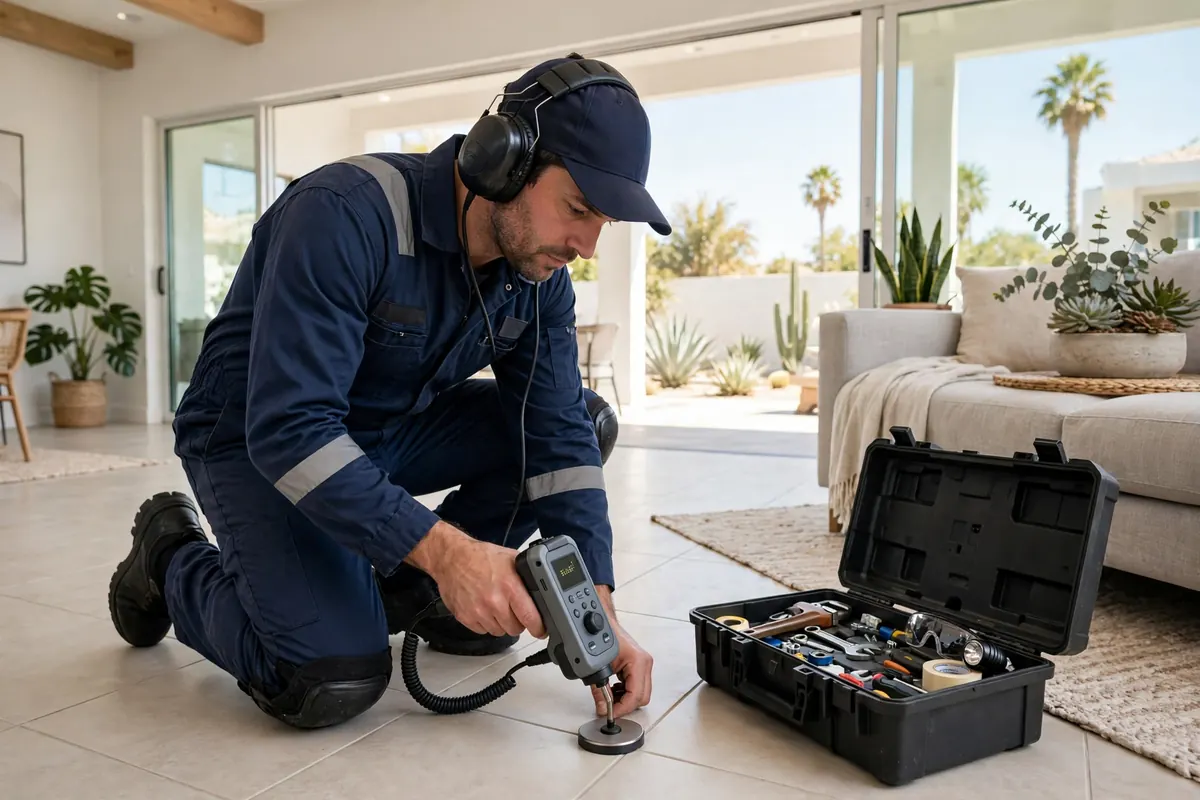
The inspection reveals the defects that matter: tree-root intrusion at joints, cracks and fractures, bellies (sagging sections that trap waste), offset or separated joints, corrosion and scale buildup, blockages, and occasionally foreign objects. Each finding is visible on the monitor in real time — you're looking at your own pipe, not a diagram.
Root intrusion deserves special mention in Hawthorne: mature street trees plus aging clay and cast-iron laterals are the classic combination, and roots exploit every tiny joint gap.
A sewer scope has become standard due diligence in Los Angeles-area home purchases — and for good reason. A lateral replacement is one of the costliest surprises a buyer can inherit, and it's invisible without a camera. For Hawthorne's mid-century housing stock, where original drain lines are now 60+ years old, scoping before close is simply prudent.
Ask whether your provider supplies the video recording and a written findings summary — documentation you can share with agents, sellers, or contractors.
Finding the defect is only half the job; the camera head carries a locator transmitter, so the technician can trace its signal from the surface and mark the exact position — and depth — of each problem on the ground with paint. That turns a potential trench-the-whole-yard repair into a targeted excavation at the marked spot.
The camera enters through an existing cleanout or drain opening — no digging to perform the inspection. It is pushed through the lateral while the monitor shows the pipe's interior; the technician records the run, notes distances to each defect, and locates them from the surface. Most residential inspections take about one to two hours depending on the system's size and complexity.
Cameras show damage, not water escaping — they reveal the defect (the crack, the root mass, the belly), which is what a repair decision needs. They also can't pass a fully blocked pipe; a severe blockage usually needs clearing first, then scoping. And the inspection is diagnostic: it documents what's wrong so repair options can be discussed separately — it doesn't fix anything itself.
One practical note: heavy root intrusion can block the camera's passage entirely. In that case the line is typically cleared first and then scoped, so the camera can reveal what the roots were exploiting.
The camera enters through an existing cleanout or drain opening — no excavation to inspect.
The CCTV head travels the lateral while the monitor shows the pipe interior in real time.
A transmitter on the camera head lets us mark each defect's surface position and depth.
You receive the video recording plus a findings summary with distances and defect descriptions.
We explain what was found in plain language so you can decide on repair options with full information.
A definitive yes-or-no test for drain-line integrity beneath your foundation — before anyone digs.
Learn more →From the meter to your house — we trace underground supply-line leaks to their source.
Learn more →Under-slab leaks found and marked without breaking concrete — until the repair needs one precise opening.
Learn more →Leak surveys for buildings that can't afford downtime — documented and minimally disruptive.
Learn more →Every day a hidden leak runs, the water bill climbs and the damage spreads. Call now — we answer 24 hours a day.
+1 424-544-0197 ☎ Call Now Request Leak Detection Service