Electronic listening that finds hidden leaks through concrete, soil, and flooring — no demolition.
Water escaping from a pressurized pipe produces a distinct sound — a hiss or vibration that travels along the pipe wall and through the surrounding ground. Acoustic leak detection uses sensitive ground microphones and contact sensors to hear that sound and trace it to its loudest point, directly above the leak.
In Hawthorne, where the median home was built around 1970 and many 1950s–60s ranch houses still run on original galvanized and cast-iron lines, acoustic listening is the workhorse method. Sensors rest on the surface — floors, soil, pavement — so nothing is drilled or dug up just to locate the problem.
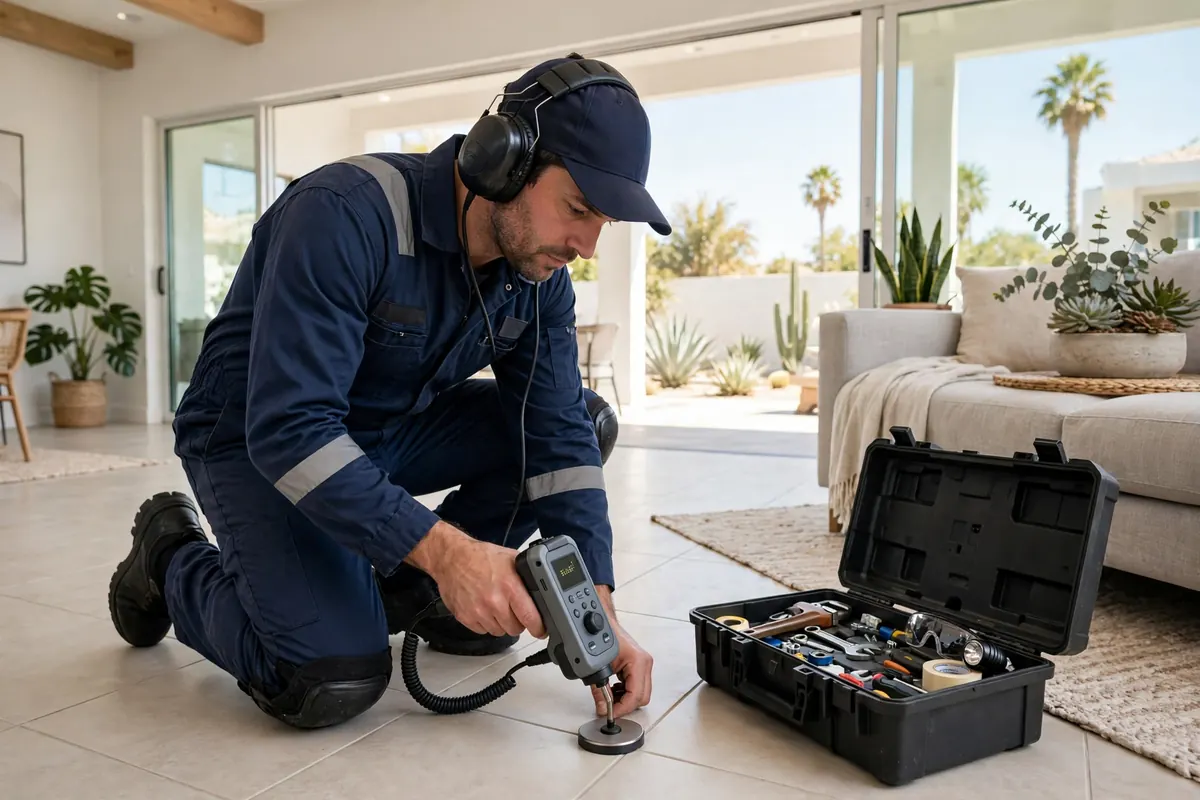
A technician places contact sensors on accessible points — hose bibs, valves, meters — and compares the leak's vibration across them to identify which pipe run is involved. Then a ground microphone sweeps the surface above the line: the signal grows louder approaching the leak and fades past it, narrowing the location to a small area. On longer runs, a correlator with two sensors can triangulate the distance mathematically from the time difference of the sound's arrival.
The essential requirement is pressure — a drained or isolated line makes no sound. That is why a quick pressure check usually comes before the listening begins.
Acoustic methods are strongest on pressurized supply lines: copper and galvanized water lines under slabs, service lines between the meter and the house, and hot-water loops. Sound travels well through concrete, making this one of the best approaches for slab leaks in Hawthorne's post-war ranch housing.
It also works through soil and pavement, so a main-line leak can be traced across a yard or driveway without exploratory digging. Where background noise is high or pipe is plastic (which muffles sound), we confirm with a second method such as tracer gas or thermal imaging rather than guessing.
Acoustic listening is less effective on gravity drains and sewer lines, which carry no pressure and make little noise — those are diagnosed with a sewer camera inspection instead. Very small pinhole leaks at low pressure can be faint, and heavy ambient noise can mask the signal.
A professional survey never relies on one instrument alone. When acoustic results are inconclusive, pressure-isolation testing confirms which line is losing water, and tracer gas or thermal imaging finishes the pinpoint. You get a marked location, not a vague area.
With a median construction year of 1970, Hawthorne's pipes are operating deep into the years when failures begin: galvanized steel corrodes from the inside, cast-iron joints separate, and copper develops pinhole leaks. These start as hidden, pressurized losses — exactly what acoustic equipment is built to hear.
With roughly 70% of Hawthorne households renting, landlords and property managers face these calls often. A one-visit acoustic survey that marks the leak's position turns a potential tear-up-the-floor job into a single targeted opening — less downtime, less tenant disruption.
A no-use meter test confirms water is actually escaping before any equipment is deployed.
Valves narrow the loss to a section — hot vs. cold, interior vs. service line.
Electronic sensors on fittings compare leak noise across points to identify the run.
A ground microphone follows the signal to its peak — the leak's position.
The location is marked on the surface and documented for any targeted repair.
Under-slab leaks found and marked without breaking concrete — until the repair needs one precise opening.
Learn more →Infrared cameras that read the heat signature of hidden moisture — a non-contact scan with zero damage.
Learn more →A safe, inert tracer gas that escapes at the defect and leads us straight to hidden water-pipe leaks.
Learn more →From the meter to your house — we trace underground supply-line leaks to their source.
Learn more →Every day a hidden leak runs, the water bill climbs and the damage spreads. Call now — we answer 24 hours a day.
+1 424-544-0197 ☎ Call Now Request Leak Detection Service