Infrared cameras that read the heat signature of hidden moisture — a non-contact scan with zero damage.
Water changes the temperature of the materials it touches. An infrared camera reads those tiny surface-temperature differences and paints them as a color-mapped image — a thermogram — revealing the footprint of hidden moisture inside walls, under floors, and above ceilings without opening anything.
Thermal imaging is often the first scan in a professional survey: it covers broad areas fast and shows where water has traveled, not just where it surfaced. In Hawthorne's slab ranch homes, it is especially valuable for tracing warm spots from hot-water lines leaking beneath concrete floors.
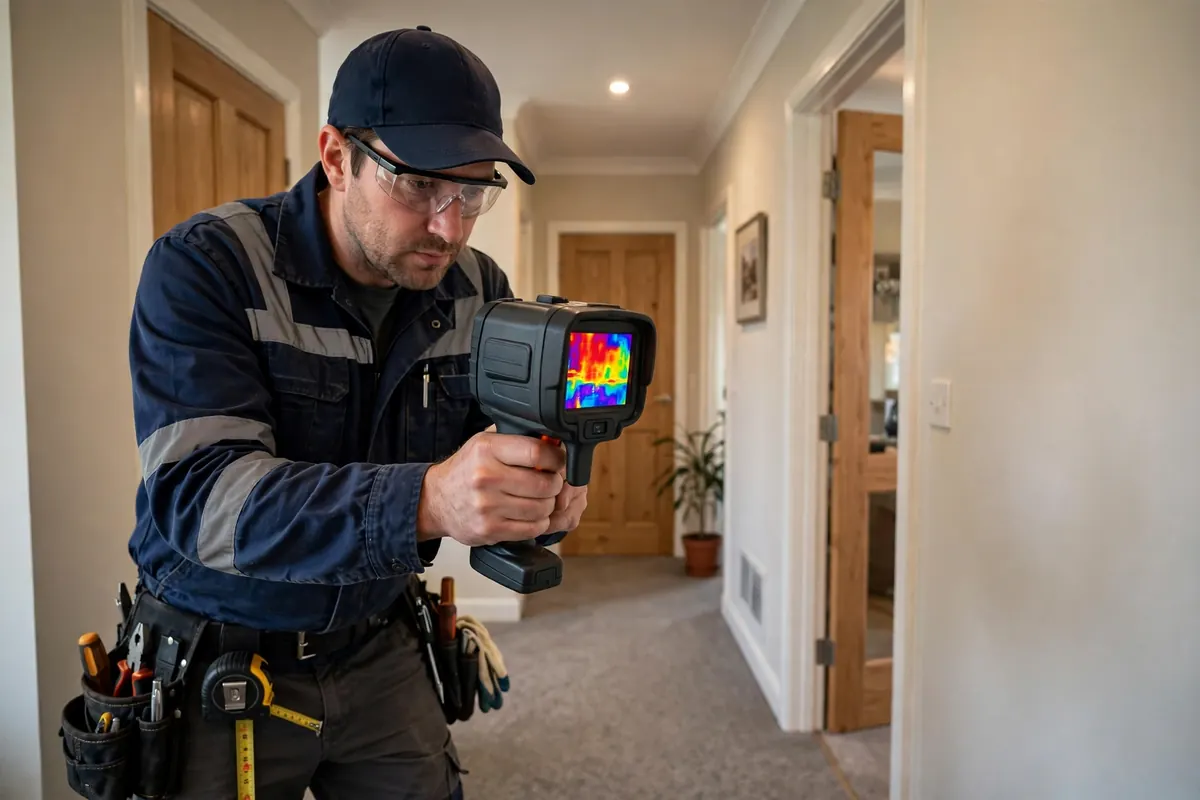
An infrared camera does not see water — it sees surface temperature. A hot-water pipe leaking under a floor leaves a warm trail on the thermogram; a cold-water leak or established damp patch reads cooler than its surroundings because of evaporative cooling. Quality cameras detect differences as small as a fraction of a degree, enough to trace moisture tracking along joists and pipe runs before it ever breaks the surface.
The scan is entirely non-contact: the technician sweeps the camera across suspect walls, floors, and ceilings while watching the live image. Nothing is touched, drilled, or cut during the survey.
One of the most useful applications is scanning concrete slabs for the warm plume of a leaking hot-water line. The heat rises through the slab and appears on the thermogram as a distinct warm zone against the cooler floor — often far more precise than guessing from a warm feeling underfoot.
This is why thermal imaging pairs so well with slab leak detection in Hawthorne's 1950s–60s ranch housing: the camera narrows the search area in minutes, and acoustic listening then pinpoints the exact position for a single targeted opening.
Beyond finding a hot spot, infrared imaging reveals moisture patterns — how far water has spread and which direction it traveled. Water rarely surfaces directly above its source; it follows pipes, framing, and gravity. The thermogram shows that migration path, which matters because repairing the stain without finding the source guarantees a repeat visit.
Every thermal anomaly is then checked with a moisture meter — pinless for broad sweeps, pin-type for confirmation — before any location is declared final. The camera finds the suspect; the meter confirms it.
Honest limits matter. A thermal camera cannot see through walls — it reads surface temperature only, so deeply buried or well-insulated leaks may not register. Deep underground water mains are better served by acoustic listening or tracer gas, and every suspect spot must be confirmed with a moisture meter before anything is opened.
Roofs are also worth a mention: thermal cameras are used in roofing work, but roof leak diagnosis belongs to roofing contractors, not this page. Here, thermal imaging serves plumbing-leak detection in walls, floors, and ceilings.
With a median construction year around 1970, Hawthorne's homes carry decades-old plumbing inside walls and under slabs that have never been opened. A non-contact scan that surveys whole rooms in minutes — instead of cutting exploratory holes — is exactly what aging housing needs.
And with roughly 70% of local households renting, landlords and property managers need answers that don't tear up a unit. A thermal survey documents the moisture footprint in images, giving owners something concrete to act on with minimal tenant disruption.
We note your symptoms — when the stain, spot, or odor appeared, and what changed — to aim the scan intelligently.
The camera scans suspect walls, floors, and ceilings, capturing thermograms of any temperature anomalies.
Every anomaly is checked with pinless and pin-type meters to confirm elevated moisture before conclusions.
We read the moisture's migration path to trace back toward the likely source, not just the visible symptom.
Findings are marked on surfaces and documented with thermal images for any targeted next step.
Electronic listening that finds hidden leaks through concrete, soil, and flooring — no demolition.
Learn more →That stain isn't the leak — it's where the water ended up. We trace it back to the source.
Learn more →Under-slab leaks found and marked without breaking concrete — until the repair needs one precise opening.
Learn more →A safe, inert tracer gas that escapes at the defect and leads us straight to hidden water-pipe leaks.
Learn more →Every day a hidden leak runs, the water bill climbs and the damage spreads. Call now — we answer 24 hours a day.
+1 424-544-0197 ☎ Call Now Request Leak Detection Service