Losing water? We'll prove whether it's evaporation or a leak — then find exactly where.
A dropping pool level starts an anxious guessing game: is it just evaporation, or is water escaping somewhere expensive? Pool and spa leak detection answers that question definitively — first with simple tests you can run yourself, then with professional pressure, dye, and acoustic testing that pinpoints the failure.
This page covers pools and spas/hot tubs together — the diagnostic approach is the same, and splitting them would just duplicate the advice. Equipment pads, plumbing runs, and shell fittings are all in scope.
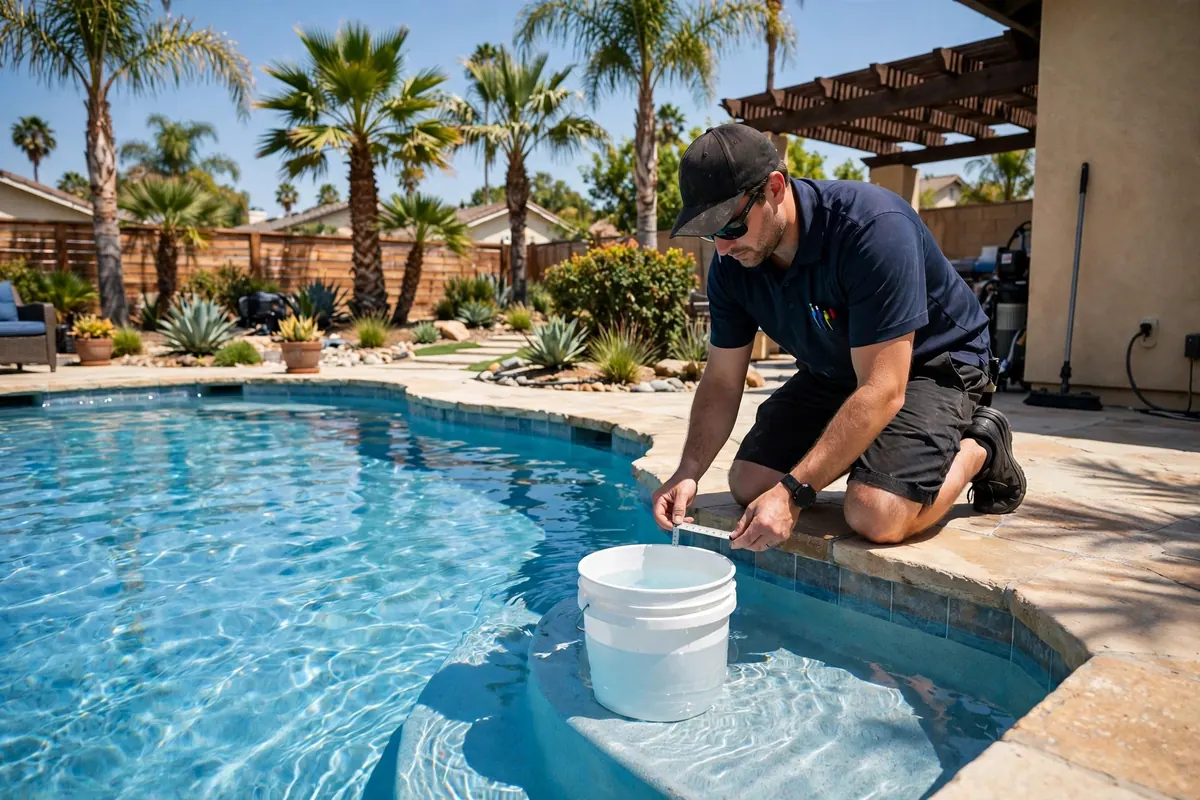
The definitive home test: place a bucket filled with pool water on a pool step, mark the water levels inside the bucket and on the pool wall, and wait 24 hours. The bucket is your evaporation control — if the pool drops noticeably more than the bucket, water is leaving through a leak, not the air.
For context, normal evaporation runs about 1/8 to 1/4 inch per day. Consistently losing more than that points to a leak worth finding.
Run the bucket test twice — once with the pump running, once with it off. Losing more water with the pump on implicates the pressure side: underground return plumbing or equipment-pad piping. Losing more with the pump off points to the shell, skimmer, or main drain. This single comparison halves the search area before any instrument comes out.
Experience narrows the suspects: skimmer throats (the concrete-to-plastic joint moves and cracks), light niches and cable conduits, return fittings, underground suction and return plumbing, and structural cracks in the shell. Each has a characteristic signature that testing confirms rather than assumes.
After the visual inspection (skimmer, fittings, equipment pad), lines are pressure-tested individually — each run is isolated and watched for pressure loss. Suspect cracks get a dye test: with the pump off, dye is released near the crack and visibly drawn into the defect. Underground plumbing leaks are traced with electro-acoustic listening, the same physics as indoor acoustic detection.
Testing runs from least to most invasive: visual and dye first, then isolated pressure tests on individual lines, then acoustic listening for buried runs. Each step either finds the failure or eliminates a suspect, so the search converges instead of wandering — and a thorough diagnostic visit typically resolves the question in one appointment.
Pool service companies maintain water; leak detection specialists diagnose it. If the bucket test says leak, a detection visit identifies the exact failure — skimmer, line, or shell — so whoever repairs it opens the right spot once. Detection first, repair second, in that order.
Bring your bucket-test results to the visit — pump-on versus pump-off readings tell the technician where to start, which shortens the diagnostic time and keeps the focus on confirming rather than rediscovering.
We review your water-loss pattern and any tests you've already run — including pump-on vs. pump-off results.
Skimmer, returns, light niches, equipment pad, and visible plumbing are checked for suspects.
Pump-on vs. pump-off comparison narrows the leak to pressure side, shell, or fittings.
Lines are pressure-tested, suspect cracks dye-tested, and underground runs listened to.
The failure point is identified and documented so repair is targeted, not exploratory.
Electronic listening that finds hidden leaks through concrete, soil, and flooring — no demolition.
Learn more →From the meter to your house — we trace underground supply-line leaks to their source.
Learn more →Under-slab leaks found and marked without breaking concrete — until the repair needs one precise opening.
Learn more →Every day a hidden leak runs, the water bill climbs and the damage spreads. Call now — we answer 24 hours a day.
+1 424-544-0197 ☎ Call Now Request Leak Detection Service