A definitive yes-or-no test for drain-line integrity beneath your foundation — before anyone digs.
Some leak questions need a simple answer first: is there a leak at all? A hydrostatic test answers exactly that for drain and sewer lines. An inflatable test ball seals the main line at the cleanout, the system is filled with water to slab level, and the level is watched for 15–20 minutes. A drop means a drain leak exists somewhere in the system.
Two clarifications matter. First, hydrostatic testing is primarily a drain/sewer diagnostic — the supply-line equivalent is called a static test (a pressure gauge on a hose bibb with the meter off). Second, this has nothing to do with fire-sprinkler hydrostatic testing, which is a separate regulated trade. This page covers plumbing drain and supply-line integrity testing only.
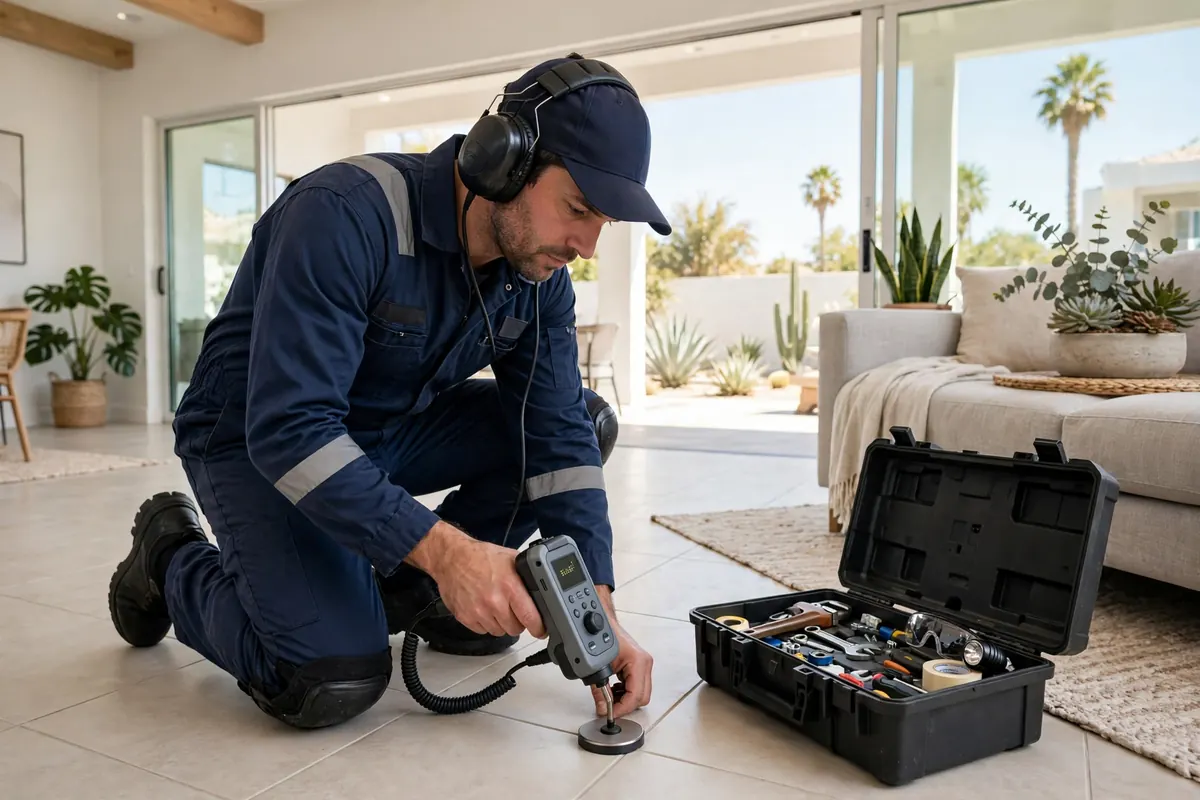
The technician inserts an inflatable test ball into the main sewer cleanout and expands it to seal the line. The drain system is then filled with water up to foundation or slab level, and gauges are monitored for roughly 15–20 minutes. If the water level holds, the system is sound; if it drops, a leak exists somewhere in the drain piping.
Everything happens through existing access points — the cleanout, sometimes with a toilet temporarily removed. Nothing is excavated to perform the test.
For pressurized supply lines, the equivalent procedure is the static test: a pressure gauge goes on a hose bibb, the water meter is shut off, and the gauge is watched for a pressure drop. Like its drain-side cousin, it answers whether a leak exists — not where it is.
Isolation or segment testing can then narrow which line or section is failing, before pinpointing methods take over.
A dropping level (or pressure) confirms a leak exists, full stop. The next step is isolation testing to determine which section is involved, followed by the tools that show the defect: a sewer camera inspection for drain lines, or acoustic listening for supply lines.
Think of hydrostatic testing as the gatekeeper: it tells you whether the expensive pinpointing work is warranted, so you're never chasing a leak that isn't there.
The test matters most in older houses — particularly pre-1980 homes with cast-iron drain lines, which describes much of Hawthorne's housing stock. Common triggers include a home purchase (buyers verifying what they're inheriting), foundation movement or foundation-lift work, persistent sewer odors, and suspected under-slab drain leaks.
It is also used after repairs to verify a line now holds — a clean yes/no before the job is considered complete.
It is not leak pinpointing — it confirms presence, not position. It is not fire-sprinkler hydrostatic testing (a separate NFPA-regulated trade). And it is not regulated backflow testing. Keeping those boundaries straight is part of doing the job honestly.
We work through the main cleanout (occasionally removing a toilet for access) — no excavation.
An inflatable test ball is positioned and expanded to seal the main drain line.
The system is filled with water to slab or foundation level, per standard procedure.
Gauges and water level are watched; a drop indicates a drain leak somewhere in the system.
A holding system is documented as sound; a failing one moves to isolation testing and camera inspection.
A camera inside your sewer lateral showing exactly what's wrong — roots, cracks, bellies — on live video.
Learn more →Under-slab leaks found and marked without breaking concrete — until the repair needs one precise opening.
Learn more →Electronic listening that finds hidden leaks through concrete, soil, and flooring — no demolition.
Learn more →From the meter to your house — we trace underground supply-line leaks to their source.
Learn more →Every day a hidden leak runs, the water bill climbs and the damage spreads. Call now — we answer 24 hours a day.
+1 424-544-0197 ☎ Call Now Request Leak Detection Service