A safe, inert tracer gas that escapes at the defect and leads us straight to hidden water-pipe leaks.
Important distinction: this page describes finding water pipe leaks with an inert hydrogen-nitrogen gas mix — it is not natural-gas leak detection. If you smell gas (a rotten-egg odor), evacuate everyone immediately, do not touch switches or phones, and call 911 or the gas utility from a safe distance. Never investigate a suspected gas leak yourself.
With that clear: tracer gas is one of the most precise tools for water-pipe leaks that other methods can't hear or see. The pipe section is drained and charged with the gas; being lighter than air, it escapes through even a pinhole defect and rises to the surface, where a sensitive probe follows the plume to the exact location — through concrete, soil, and flooring.
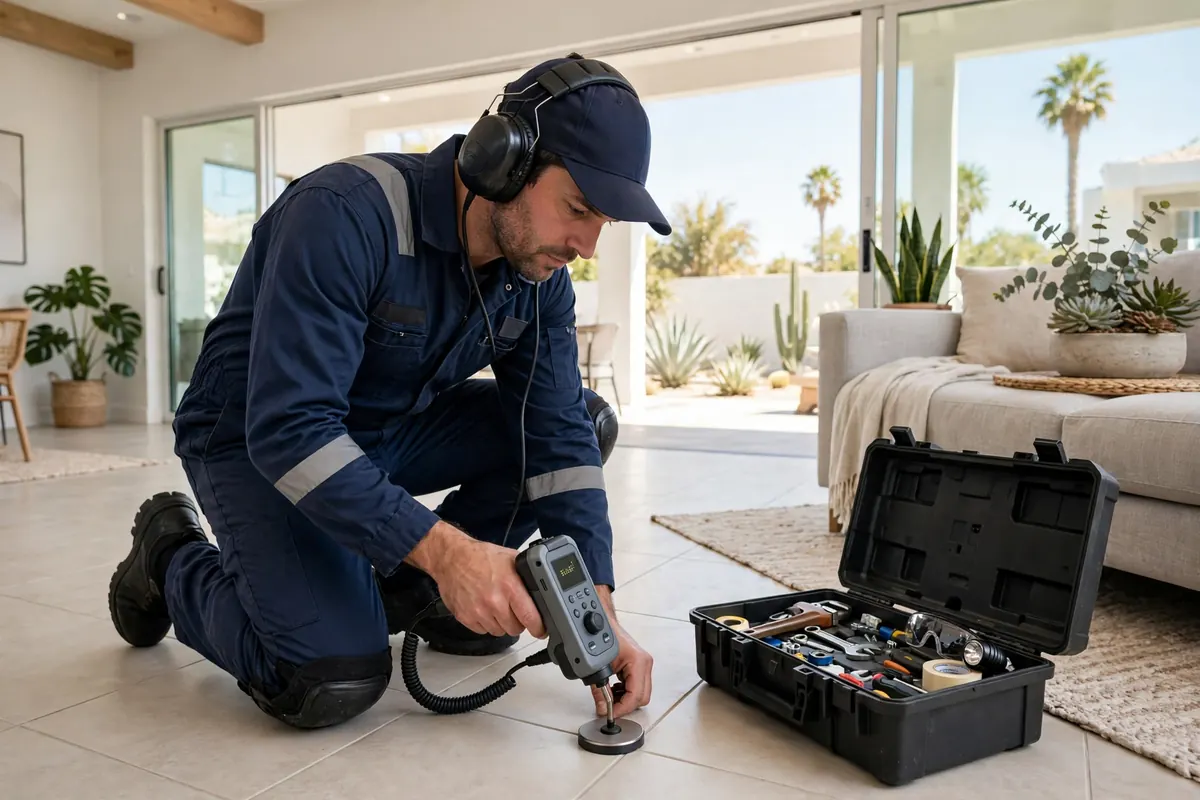
The gas used is typically a forming gas: about 95% nitrogen and 5% hydrogen. At that composition it is non-toxic, non-corrosive, non-flammable, and odorless — and it dissipates quickly once the test ends. Helium is sometimes used as an alternative tracer, though the hydrogen-nitrogen mix is now predominant.
Critically, this has nothing to do with the natural gas in your home's gas lines. Tracer gas goes into water pipes as a diagnostic tool. Suspected natural-gas leaks are a safety emergency — see our gas line leak detection page and the safety guidance above.
The section under test is isolated and drained — the gas needs the pipe to itself. It is then charged with the tracer mix at controlled pressure. The ultra-light gas creeps out through the smallest defect and migrates upward through soil, concrete, or flooring. A sensitive locating probe (bell or carpet probe) is swept across the surface, following the rising plume to its strongest point: the leak.
The location is marked, photographed, and documented. The pipe is then flushed and returned to service — the section is only out of use for the duration of the survey.
Acoustic listening is the usual first method, but it has blind spots: plastic pipe absorbs sound, deep lines attenuate it, noisy environments mask it, and micro-leaks barely whisper. Tracer gas doesn't rely on sound at all, so it succeeds exactly where listening struggles.
In practice, tracer gas is often the second method deployed after an inconclusive acoustic survey — the two are complementary, not competing. A professional finds the leak with whichever physics the situation favors.
Because the gas is non-toxic and non-corrosive at the 5% hydrogen composition, it is safe for use in drinking-water lines. It carries no odor, leaves no residue, and the tested section is flushed before being put back into service. The main practical consideration is access: the line must be isolatable and drainable, which your technician will verify before scheduling.
Hawthorne's mid-century housing often mixes pipe materials — original galvanized or copper plus later plastic repairs — which is exactly the scenario where acoustic results get murky and tracer gas earns its keep. It is also a key method for under-slab leaks where the line runs deep or the slab assembly dampens sound, and for service lines where the leak is suspected but nothing can be heard at the surface.
The suspect section is valved off and drained so the tracer gas has the pipe to itself.
The hydrogen-nitrogen mix is introduced at controlled pressure through an access point.
The light gas escapes at the defect and rises through soil, concrete, or flooring to the surface.
A sensitive detector sweeps the surface, following the plume to its peak concentration.
The location is marked, photographed, and reported; the line is flushed and restored.
Electronic listening that finds hidden leaks through concrete, soil, and flooring — no demolition.
Learn more →Under-slab leaks found and marked without breaking concrete — until the repair needs one precise opening.
Learn more →From the meter to your house — we trace underground supply-line leaks to their source.
Learn more →Safety first, always — professional gas-line inspection for Hawthorne homes and businesses.
Learn more →Every day a hidden leak runs, the water bill climbs and the damage spreads. Call now — we answer 24 hours a day.
+1 424-544-0197 ☎ Call Now Request Leak Detection Service